Just leaving service: what the data and the program rules actually say about the first stretch.
You said you're . Start with the window that fits.
Where are you in the timeline? (optional; it opens the page on the window that fits)
No public dataset anywhere, for Illinois or the country, tracks how long it actually takes a veteran to land a first civilian job after separation. That data lives inside the Department of Defense and VA's internal systems, and it isn't released. What public data and published program rules CAN show: where VA education and vocational-rehabilitation dollars already flow across Illinois counties, how many Illinois veterans are the newest generation, the general employment picture next to the current national numbers for post-9/11 veterans specifically, and the actual clocks that run before and after you separate. This page lays those out plainly, including what it can't prove.
Your trade-offs
Showing starting points for every value. Pick values on the main page to see yours highlighted here.
Money and security
| Value | What you'd gain | What you'd give up |
|---|---|---|
| Income / earning ceiling | Filing for disability compensation before you separate, through the VA's Benefits Delivery at Discharge program, can put a decision closer to your discharge date instead of months of gap. | Illinois veteran earnings by career stage aren't this page's data. If income growth over time is the bigger question, the Career-changer path has more to say. |
| Security / stability | National research finds veteran unemployment runs higher right after separation, then falls rapidly with time. It isn't a permanent state. | The public data can't tell you how long your own first stretch will run. No dataset tracks any individual veteran's path from separation to first paycheck. |
| Getting out of debt | Federal VA benefit dollars, including Education & Vocational Rehabilitation and Employment funding, already flow to every Illinois county, so support isn't concentrated in a few places. | That spending is a small share of total VA spending per county, a few percent in most places. It isn't a debt-relief program by itself. |
| Legacy / multi-generational | Records and ratings you establish now (service-connected disability, education benefits used or preserved) can matter for decades, including for dependents on some benefits. | This page is built around the first stretch after service. It doesn't track what outlasts a whole career; the Wealth-steward path looks further out. |
Self-direction and growth
| Value | What you'd gain | What you'd give up |
|---|---|---|
| Autonomy / self-direction | The Transition Assistance Program (TAP) lets you pick your own track (Employment, Vocational, Education, or Entrepreneurship), and you can attend more than one. | The program itself isn't optional and runs on a clock: it must start no later than 365 days before you separate, whether or not that timing suits you. |
| Growth / learning | TAP is a real curriculum with a defined endpoint (a Capstone review 90 days before separation confirming you're on track), not an open-ended course. | It's designed as a floor, not a full career plan. If training into a new trade is the actual goal, the Skill-builder path goes deeper on the GI Bill and apprenticeships. |
| Mastery / craft | Nothing about separating erases skills built in uniform; several benefit programs exist specifically to translate them. | This page doesn't measure how well any specific military skill transfers to a specific civilian trade. That's closer to the Skill-builder path's territory. |
| Adventure / new experiences | Leaving service is itself one of the biggest life changes most veterans make; what comes after is genuinely open. | Openness cuts both ways here. The same lack of a set path that creates room for adventure is also what makes the first stretch harder to predict. |
People and connection
| Value | What you'd gain | What you'd give up |
|---|---|---|
| Family / partner / parenting time | The PACT Act extended combat-veteran VA health care eligibility to 10 years after discharge, and the Transitional Assistance Management Program (TAMP) can bridge TRICARE coverage for the household right after separation, for those who qualify. | Both windows are categorical, not automatic for everyone. Confirming your own household's eligibility takes a real conversation with TRICARE or VA, not a guess. |
| Love / partnership | Getting the paperwork windows right (TAP, the disability claim window, TRICARE) removes some of the uncertainty a partner also carries through a transition. | No public research on this page's sources measures how transition timing specifically affects relationships. That's a real gap, not a finding. |
| Community / friendship | Research on veterans who stay socially connected consistently finds better reported health and stronger relationships after service. | Only 8% of veterans in one national survey said they frequently felt disconnected after leaving the military, but that rate is roughly triple among veterans with traumatic experiences. Disconnection is a real risk, not a rare one, for some. |
Body, mind, and time
| Value | What you'd gain | What you'd give up |
|---|---|---|
| Physical health | Filing a pre-discharge disability claim requires your Service Treatment Records no later than 90 days before separation, which pushes a real health-record review to happen while you still have easy access to military medical staff. | Getting this right takes deliberate effort during an already busy final year of service. It doesn't happen automatically. |
| Mental health / stress | The PACT Act's 10-year VA health care window and VA's enrollment process are separate from your final active-duty paycheck, so care doesn't have to depend on finding a civilian job first. | Enrollment is separate and not automatic. It has to be started, and several eligibility categories are conditional, not universal. |
| Time / freedom of schedule | Once separated, nothing about your schedule is set by an institution anymore. | Before separation, TAP is a real time commitment layered on top of your remaining duties, and it starts a year out whether your schedule is light or heavy that year. |
Meaning and service
| Value | What you'd gain | What you'd give up |
|---|---|---|
| Purpose / meaning | Many veterans describe finding a new sense of purpose after service, sometimes through the very organizations built to help other veterans transition. | This is the most-reported gap after separation in national surveys, and no dataset on this page measures it directly. The survey below asks about yours. |
| Faith / spiritual practice | Once your schedule is your own again, a consistent practice is easier to protect than it may have been on a duty schedule. | The paperwork windows in the months before separation don't pause for anything, faith practice included. |
| Service / impact | The transition itself often becomes the first place veterans find informal ways to help others going through the same thing. | If direct, ongoing service to the veteran community is the actual goal rather than a phase, the Advocate path is built around that question. |
| Patriotism / love of country | The benefits this page covers (the GI Bill, Veteran Readiness and Employment (VR&E), PACT Act health care, disability compensation) are the country's continuing obligation for your service, not charity. | None of them require continued affiliation with the military to use. Using them fully is simply claiming what you already earned. |
The value you added:
What would a good transition mean for it, and what might it cost? Use the reflection questions below.
These are starting points, not scores. Nothing here is weighted or ranked for you.
The Illinois data
Three views, read in order: where VA education and training dollars already flow, how many Illinois veterans are the newest generation, and the employment picture. First, the honest limit on all three: no public dataset measures how long it actually takes any veteran to go from separation to a first civilian job, in Illinois or anywhere. That data sits inside DoD and VA's internal systems and isn't released as public data. Everything below works around that wall, not through it.
Where VA education and training dollars already flow
The VA publishes an annual estimate of its own spending by county: the Geographic Distribution of VA Expenditures (GDX). Education & Vocational Rehabilitation/Employment (EVRE) is one category inside it. Shown here against the total, on purpose: EVRE is a real but small slice of what VA spends per veteran in every county, and showing it alone would overstate how much of VA's footprint is transition-specific.
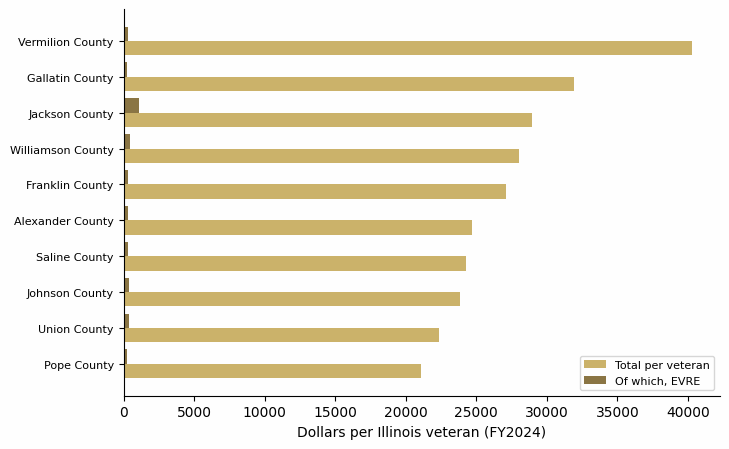
The 10 Illinois counties where VA spends the most per veteran, and the Education & Vocational Rehabilitation/Employment (EVRE) slice inside that total. Statewide, EVRE is $261 million of $7.48 billion in total VA spending across Illinois, about 3.5 percent. Compensation and Pension, not shown here, makes up most of the rest. Fiscal year 2024. [Source: U.S. Department of Veterans Affairs, National Center for Veterans Analysis and Statistics, Geographic Distribution of VA Expenditures (GDX), Fiscal Year 2024, accessed July 2, 2026 at va.gov/VETDATA. This product is not endorsed or certified by the Department of Veterans Affairs. Veteran-population denominator: U.S. Census Bureau, American Community Survey 5-year estimates (table B21001).]
What this can and can't tell you: this is spending, not outcomes. It says where VA's education and vocational-rehabilitation dollars land, not whether any veteran who used them found or kept a job. VA's own guidance also cautions against treating these dollars as a per-participant benefit amount; the per-veteran figures here are a rough scale comparison across counties, not an individual benefit estimate.
This is information, not advice. You decide if it applies.
How many Illinois veterans are the newest generation
Census tracks veterans by period of military service, not years since separation. The closest public proxy for "the newest generation" is the post-9/11 (Gulf War-era II) category: everyone who served any time from September 2001 to today, nearly 24 years. It is not the same as "recently separated."
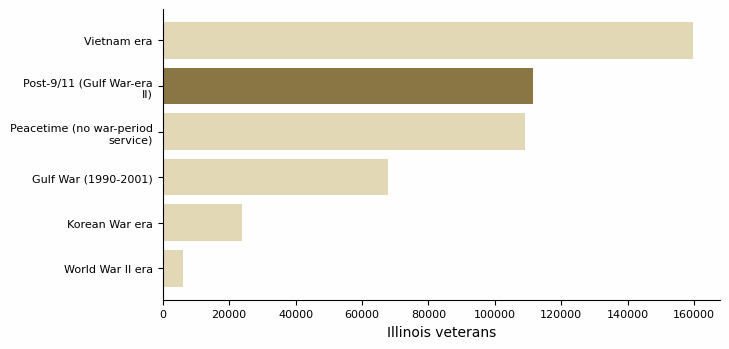
Illinois veterans by period of military service. 111,588 Illinois veterans, about 23 percent of all Illinois veterans, served in the post-9/11 era (Gulf War-era II, September 2001 to today), the darker bar. This is a period-of-service group spanning nearly 24 years, not a count of veterans who recently separated. American Community Survey, 2020-2024 5-year estimates. [Source: U.S. Census Bureau, American Community Survey 5-year estimates (table B21002). This product uses the Census Bureau Data API but is not endorsed or certified by the Census Bureau.]
What this can and can't tell you: it's a headcount by service-era category, not a "years since discharge" measure. Someone who separated in 2003 and someone who separated last month are in the same post-9/11 bucket here.
This is information, not advice. You decide if it applies.
The employment picture
Illinois veteran unemployment, all service eras combined, next to the Illinois nonveteran rate, both from the Census Bureau's American Community Survey (ACS). Because no public table crosses Illinois, service era, and employment status, the post-9/11-specific rate can only come from the U.S. Bureau of Labor Statistics (BLS)'s national release, never a state cut. Both are shown, clearly labeled by geography, never blended into one number.
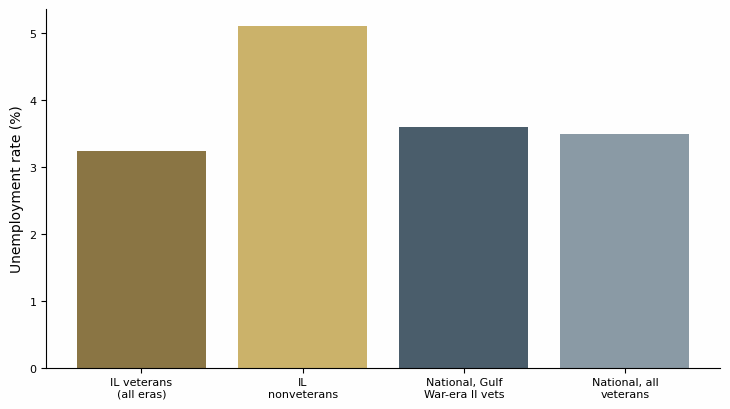
Illinois veteran unemployment (all service eras, 3.2 percent), computed the same way as the Founder path's own American Community Survey pipeline so the two pages can never disagree, next to the Illinois nonveteran rate (5.1 percent) and the current national rates for veterans specifically in the post-9/11 era (3.6 percent) and for all veterans (3.5 percent). The national figures are not Illinois-specific: no state-level breakdown of veteran unemployment by service era exists in public data. BLS, Employment Situation of Veterans, 2025, released April 28, 2026. [Sources: U.S. Census Bureau, American Community Survey 5-year estimates (table B21005), accessed July 2, 2026, computed the same way as the Founder path's own pipeline; U.S. Bureau of Labor Statistics, Employment Situation of Veterans, 2025 (USDL-26-0666), released April 28, 2026, accessed July 2, 2026. BLS.gov cannot vouch for the data or analyses derived from these data after the data have been retrieved from BLS.gov.]
What this can and can't tell you: the Illinois figure covers all veteran eras, not post-9/11 veterans specifically; the national figure is post-9/11-specific but isn't Illinois. There's no single number that is both. National research (below) explains why recently separated veterans often see higher unemployment at first, and why that gap tends to close with time.
This is information, not advice. You decide if it applies.
The benefit clock
Four real clocks run around separation. None of them wait for you to be ready.
Before separation
Two clocks start before you're out, and both reward starting early. The Transition Assistance Program (TAP) must begin no later than 365 days before you separate (retiring service members should start closer to two years out), with a Capstone review confirming you're on track no later than 90 days before separation. Separately, the VA's Benefits Delivery at Discharge (BDD) program lets you file a disability claim while you're still on active duty, between 180 and 90 days before your separation date, so a decision can land closer to your discharge date instead of months after. Missing either window doesn't close the underlying benefit, but it usually means starting from further behind.
[Military OneSource, DoD Transition Assistance Program (TAP) pages; VA.gov Benefits Delivery at Discharge (BDD) pages.]
This is information, not advice. You decide if it applies to your situation.
The handoff window
Military health coverage ends at separation, and the bridge is narrower than most people expect. The Transitional Assistance Management Program (TAMP) provides 180 days of premium-free TRICARE after separation, but only for certain categories (involuntary separation under honorable conditions, post-contingency-operation service, and a few others). VA health care enrollment is separate and not automatic. Coverage gaps during a business launch or a job search are common and avoidable: your specific window is verifiable at TRICARE.mil and VA.gov before your separation date, not after.
[TRICARE.mil, Transitional Assistance Management Program (TAMP); VA.gov health care enrollment.]
This is information, not advice. You decide if it applies to your situation.
After you're out
Your separation year changes your benefit clock. If you separated before January 1, 2013, your Post-9/11 GI Bill expires 15 years after your last separation, and Veteran Readiness and Employment (VR&E) gives you 12 years from separation or your first VA disability rating, whichever is later. If you separated on or after January 1, 2013, neither clock applies: the Post-9/11 GI Bill never expires (Forever GI Bill) and VR&E has no time limit either. Check your specific timeline at VA.gov.
[VA.gov, Post-9/11 GI Bill and Veteran Readiness and Employment (VR&E) eligibility pages.]
This is information, not advice. You decide if it applies to your situation.
If you deployed to a combat zone, the PACT Act of 2022 extended your window to enroll in VA health care with enhanced eligibility from 5 years to 10 years from your discharge or separation date. During that window you can get free VA health care for any condition related to your service, without filing a disability claim first. This runs on a separate clock from TRICARE and TAMP above: it's about ongoing VA health care, not the bridge coverage right after you leave. Confirm your own dates at VA.gov/PACT.
[VA.gov, "The PACT Act and Your VA Benefits"; VA.gov health care eligibility pages.]
This is information, not advice. You decide if it applies to your situation.
What tends to predict a good landing
Each finding closes the same way on purpose: this is information, not advice. You decide if it applies.
-
It's usually harder at first, and it usually gets better.
Between 2000 and 2011, younger veterans were on average 3.4 percentage points more likely to be unemployed than nonveterans of the same age and background, and young veteran unemployment reached 29% in 2011 at the depth of that downturn. That gap falls rapidly with age and time since separation. Where things stand now: BLS's 2025 release puts post-9/11 veteran unemployment at 3.6% nationally and all-veteran unemployment at 3.5%, both close to typical labor-market levels. [RAND Corporation, Why Is Veteran Unemployment So High? (RR-284); U.S. Bureau of Labor Statistics, Employment Situation of Veterans, 2025.]
This is information, not advice. You decide if it applies.
-
About half of post-9/11 veterans say the transition was genuinely hard.
In a national survey, 48% of post-9/11 veterans said readjusting to civilian life was somewhat or very difficult, more than double the 21% of veterans whose service ended before 9/11. Combat veterans, and especially those with emotionally traumatic experiences, reported struggling the most. If this describes you, you're not the exception. [Pew Research Center, The American Veteran Experience and the Post-9/11 Generation, 2019.]
This is information, not advice. You decide if it applies.
-
Staying connected matters, and most veterans don't report losing that connection.
Only 8% of veterans in that same survey said they frequently felt disconnected from others after leaving the military, and 24% sometimes felt this way. But among veterans with traumatic experiences, that frequent-disconnection number nearly triples to 22%. Separately, one study followed veterans who stayed active in a peer community: the more they engaged, the more they reported gains in relationships, purpose, and health. Another study found that veterans who lose touch after service tend to have worse health down the line. [Pew Research Center, 2019; Angel & Armstrong, Institute for Veterans and Military Families, 2016; Angel et al., Translational Behavioral Medicine, 2018.]
This is information, not advice. You decide if it applies.
-
The paperwork windows are program rules, not a study, and no one publicly measures whether they work.
TAP, the VA's pre-discharge disability claim window, and the PACT Act's health care window are real federal rules with real deadlines, cited directly to DoD and VA above. What no public dataset can tell you: whether using them on time actually changes any individual veteran's outcome. That link isn't measured anywhere public. Use the windows because they're real deadlines with no cost to meeting them early, not because a study proves they change your outcome. [Military OneSource; VA.gov.]
This is information, not advice. You decide if it applies.
What I can't show you
- No public dataset measures how long it takes any veteran, anywhere, to go from separation to a first civilian job. That data lives inside DoD and VA's internal systems and isn't public.
- "Post-9/11 (Gulf War-era II)" is a nearly 24-year service-era category, not "recently separated." I can't tell you how many Illinois veterans separated in the last year specifically; the public data doesn't cut that finely.
- VA spending by category is spending, not outcomes. I can't tell you whether the education and vocational-rehabilitation dollars in any county actually helped anyone find work.
- There's no Illinois-specific version of the "harder at first, then it gets better" pattern. That's national research (RAND, BLS), not a local finding, because no Illinois data exists to build one.
- The VA's own spending report changed its category structure between FY2022 and FY2024, so I can't show a multi-year Illinois VA-spending trend without comparing categories that no longer match.
- No outcomes or guarantee. National patterns and program rules describe what tends to happen and what deadlines exist; neither promises anything about your specific timeline.
Should you stay or go?
If you're weighing other states, here are the same two Illinois-built measures for the states veterans often weigh against Illinois: how large the newest-generation veteran population is, and the general veteran unemployment rate. VA spending isn't compared here; a per-state spending comparison risks implying a benefit-generosity ranking the data can't honestly support.
Post-9/11 veteran share and unemployment, by state
| Measure | Illinois | Texas | Virginia | California | Florida |
|---|---|---|---|---|---|
| Post-9/11 (Gulf War-era II) share of veterans | 23% | 34% | 39% | 27% | 24% |
| Veteran unemployment rate (all eras) | 3.2% | 4.7% | 2.8% | 5.8% | 4.0% |
Both rows use the same definitions in every state: post-9/11 share from Census ACS table B21002, veteran unemployment (all eras) from Census ACS table B21005. Texas and Virginia's higher post-9/11 shares track their larger active-duty and base populations; that isn't a claim about which state serves veterans better. [Source: U.S. Census Bureau, American Community Survey 5-year estimates (tables B21002, B21005), accessed July 2, 2026.]
Weighing a specific state I didn't include? Tell me with the Share feedback link at the bottom of this page and I'll prioritize it.
Taxes change with your state
Where you legally reside changes how your military retirement and VA disability income are taxed, and what property-tax breaks you qualify for. Illinois doesn't tax retirement income, including military retirement. Texas and Florida have no state income tax, and both offer up to a full homestead property-tax exemption for 100% disabled veterans. California still taxes military retirement above a partial exclusion (up to $20,000 a year starting with tax year 2025, with income limits, and that provision is set to expire before 2030). If "should you stay or go" is a real question for you, the tax math is part of the answer. Verify against each state's revenue department before you decide.
[Illinois Department of Revenue; Texas Comptroller; Florida Statutes; MOAA state tax updates. Verify with each state's revenue department.]
This is information, not advice. You decide if it applies to your situation.
An honest check before you decide
- Have you actually put the four benefit-clock dates on a calendar (TAP start, the pre-discharge claim window, your TRICARE/TAMP end date, your PACT Act 10-year window), or are they still just "somewhere out there"?
- National research says about half of post-9/11 veterans found the transition genuinely hard, and that it tends to ease with time. If the first stretch is rough, is that a sign something's wrong, or the normal pattern the research describes?
- Who's in your corner right now, on purpose, not by accident? The research on staying connected is consistent enough that this is worth naming, not assuming.
Thinking further out, past the first job? See the Career-changer path for how income tends to move over a longer switch, or the Skill-builder path for training options using the GI Bill.
Before you go
Get updates when new data or a new path ships (one confirmation email first, unsubscribe anytime). Or answer three quick feedback questions; your answers tell me whether to keep building these.
Support the work · offsets the data and build costs. Optional.