Training into a trade in Illinois on the GI Bill: what the public data actually shows.
You're seeing this with first.
Investing in yourself first means trading time now for a skill that pays later. On the GI Bill you can train into a skilled trade through an apprenticeship or on-the-job program, draw a housing stipend while you learn, and come out with a credential that holds its value in Illinois. The catch is the clock: the training takes months or years up front, and your benefit clock can be running while you train. This page lays out the real Illinois menu, what the trades pay, and the timing honestly, so you can plan the trade-off instead of being surprised by it. What the data can't decide is whether the work fits you. That part is yours.
Your trade-offs
Showing starting points for every value. Pick values on the main page to see yours highlighted here.
Money and security
| Value | What you'd gain | What you'd give up |
|---|---|---|
| Income / earning ceiling | A skilled trade can pay well in Illinois once you finish, and you train without paying tuition. | The bigger paycheck comes after you finish, not while you train. The stipend covers housing, not a full wage. |
| Security / stability | A trade credential is portable and stays in demand. Licensed trades are hard to send overseas or automate away. | While you train you earn less than a full wage, so money is tighter until you finish and get hired on. |
| Getting out of debt | Training on the GI Bill means no tuition debt, and the housing stipend helps cover bills while you learn. | A stipend is not a full paycheck, so paying down what you already owe usually slows until the trade wage kicks in. |
| Legacy / multi-generational | A trade is a skill you keep for life and can teach your kids. It is standing you build from the ground up. | Building it takes years of training first. The payoff for the next generation comes after you put the time in. |
Self-direction and growth
| Value | What you'd gain | What you'd give up |
|---|---|---|
| Autonomy / self-direction | A licensed trade can lead to running your own crew or business later, on your own terms. | An apprenticeship runs on the employer's and the program's schedule. You follow their lead until you finish. |
| Growth / learning | This is the whole point of this path. You learn a real, hands-on skill from people who do it for a living. | Most of the learning is up front. The first stretch is all training before the work pays what the trade is worth. |
| Mastery / craft | Trades reward mastery. The longer you do the work, the more your skill and your pay grow. | Mastery starts at the bottom. You begin as the least experienced person on the job and earn your way up. |
| Adventure / new experiences | A trade puts you on new job sites with new problems to solve, not behind the same desk every day. | Training is repetitive by design. The variety comes later, after you have the basics down. |
People and connection
| Value | What you'd gain | What you'd give up |
|---|---|---|
| Family / partner / parenting time | A steady trade wage and more predictable hours later can give your family firmer footing. | Training years ask the household to live on a stipend first. Some programs run long, and that stretch is felt at home. |
| Love / partnership | A partner who backs the training shares in a steadier trade income down the road. | The lean training stretch is carried by both of you. Living on a stipend tests a household's patience. |
| Community / friendship | Apprenticeships put you alongside a crew, and often a trade union or veteran group that helps you land work. | Training pulls your time and energy while you learn, which can crowd out the people already in your life. |
Body, mind, and time
| Value | What you'd gain | What you'd give up |
|---|---|---|
| Physical health | Trades keep you active and on your feet instead of sitting all day. | Many trades are hard on the body over time. The physical wear is real and builds up across a career. |
| Mental health / stress | A clear path with a stipend and a credential at the end can lower the worry of not knowing what is next. | Living on less while you train is its own stress. The benefit clock running down adds pressure to decide. |
| Time / freedom of schedule | A finished trade can offer steady, predictable hours, and some trades pay overtime. | Training costs time up front, sometimes years. You spend that time before the trade buys you any freedom. |
Meaning and service
| Value | What you'd gain | What you'd give up |
|---|---|---|
| Purpose / meaning | Building something real with your hands gives many veterans a clear sense of purpose. | Purpose does not pay the training stretch. The data cannot promise the trade will feel as meaningful as you hope. |
| Faith / spiritual practice | Trade hours are often set, which can leave a steady rhythm to honor your practice once you finish. | The training stretch can be demanding and unpredictable. Living on less can test discipline of every kind. |
| Service / impact | Many of these trades, like the building trades and public safety, keep your community running and safe. | The first stretch is about learning the trade, not serving yet. The impact comes after you are trained and working. |
| Patriotism / love of country | Public-safety and skilled-trade roles let many veterans keep serving their community in civilian clothes. | The Illinois training menu leans toward public safety and construction, so it may not match every way you want to serve. |
The value you added:
How would training into a trade serve it, and what might it cost? Use the reflection questions below.
These are starting points, not scores. Nothing here is weighted or ranked for you.
The Illinois data
Five views, read in order: the menu of trades you can train into on the GI Bill in Illinois, what you earn while you train versus after, which trades line up with military experience, what each trade typically asks for to get in, and how much Illinois veterans have used these benefits before.
The menu: trades you can train into on the GI Bill in Illinois
This is the spine. It is the real, current list of GI Bill-approved apprenticeship and on-the-job-training programs in Illinois, grouped into three families, with what each trade pays in Illinois. One thing to know up front: the Illinois menu leans heavily toward public safety and the building trades, not, say, tech.
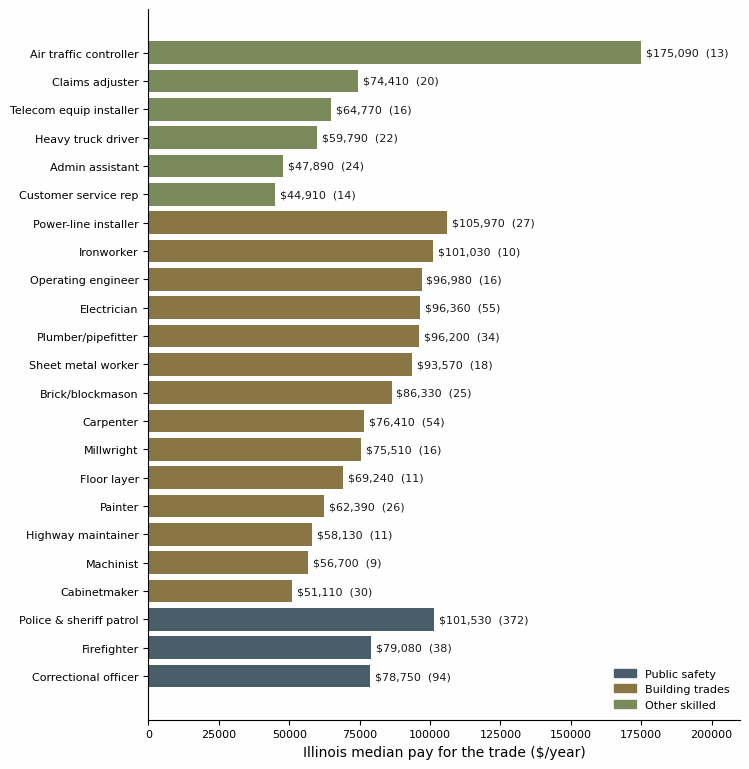
The Illinois GI Bill apprenticeship and on-the-job-training menu, grouped into three families: public safety, skilled building trades, and other skilled work. Bars show the trade's Illinois median pay (all workers in that job, not program graduates). Of 980 programs we could match to a trade, about 52% are public-safety roles (police, corrections, sheriff) and the next tier is the building trades; the Illinois menu leans toward public safety and construction, not, say, tech. 25 more programs are in smaller trades, and 324 didn't map cleanly to a single job and are left off. [Sources: U.S. Department of Veterans Affairs, GI Bill Comparison Tool (api.va.gov); Illinois pay from U.S. Bureau of Labor Statistics, OEWS, May 2024.]
What this can and can't tell you: it shows the trades you can actually train into here and what each pays across all workers in that job in Illinois. It can't tell you what a given program's graduates earn, and "leads to hiring" is structural: apprenticeships are run by employers, so they are hiring pipelines by design, not a measured placement rate.
Earn while you learn
Most schooling costs you income while you do it. An apprenticeship is built the other way: you draw a GI Bill housing stipend while you train, with no tuition, and the trade pays more once you finish. This compares the monthly stipend during training with the trade's typical Illinois pay shown per month.
Read the training bar as a floor, not your full income. The light bar is the housing stipend only. In a registered apprenticeship your employer also pays you a training wage that grows as you go, and that pay is not in this data, so what you actually earn while training is higher than the bar shows.
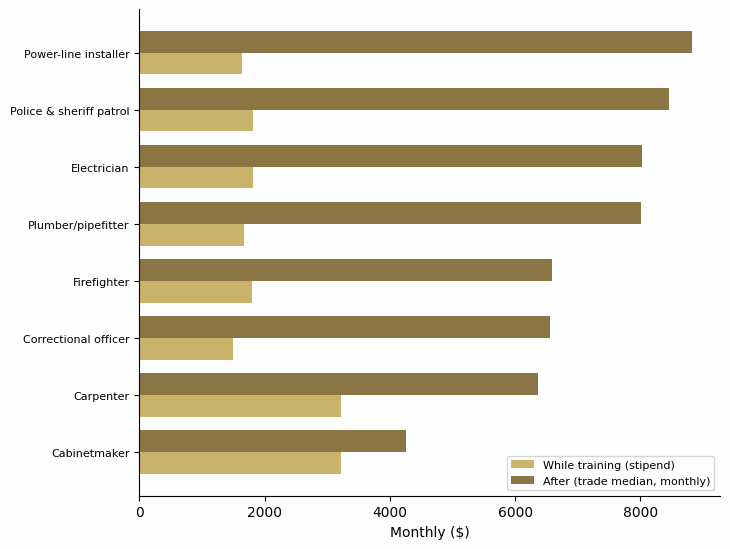
Earn while you learn. The light bar is the monthly GI Bill housing stipend you get while training in each trade; the dark bar is what that trade's typical Illinois worker earns afterward, shown per month for comparison. An apprenticeship pays you now instead of charging tuition. The stipend is housing money only, and apprenticeships also pay an employer wage that isn't in this data, so the training side is understated. [Sources: U.S. Department of Veterans Affairs, GI Bill Comparison Tool (api.va.gov), housing stipend; trade pay from U.S. Bureau of Labor Statistics, OEWS, May 2024.]
What this can and can't tell you: the stipend is housing money, not a full wage, and registered apprenticeships also pay an employer wage that is not in this data, so the training side is understated. It shows the shape of "paid while you learn, paid more after," not your exact paycheck.
Where your military experience already points
The O*NET® database, built by the U.S. Department of Labor, maps every military job to the civilian work that leans on the same skills. Below are some common Army trade roles as examples, each matched to a civilian trade that has Illinois GI Bill apprenticeships, with what it pays in Illinois and how much added training it usually takes. Find the one closest to your own service work.
-
carpentry trades e.g. 12W Carpentry and Masonry Specialist
Carpenters
$76,410 median pay, Illinois
Training to switch: Some: a few months of on-the-job training
Skills you'd carry over:
- Active Listening
- Critical Thinking
- Monitoring
- Coordination
-
electrical trades e.g. 12R Interior Electrician
Electricians
$96,360 median pay, Illinois
Training to switch: Medium: training, an apprenticeship, or a license
Skills you'd carry over:
- Troubleshooting
- Repairing
- Active Listening
- Critical Thinking
-
plumbing & pipefitting e.g. 12K Plumber
Plumbers, Pipefitters, and Steamfitters
$96,200 median pay, Illinois
Training to switch: Medium: training, an apprenticeship, or a license
Skills you'd carry over:
- Critical Thinking
- Judgment and Decision Making
- Repairing
- Troubleshooting
-
diesel & vehicle repair e.g. 91B Wheeled Vehicle Mechanic
Bus and Truck Mechanics and Diesel Engine Specialists
$62,750 median pay, Illinois
Training to switch: Medium: training, an apprenticeship, or a license
Skills you'd carry over:
- Repairing
- Troubleshooting
- Operations Monitoring
- Equipment Maintenance
-
heavy equipment operation e.g. 12N Horizontal Construction Engineer
Operating Engineers and Other Construction Equipment Operators
$96,980 median pay, Illinois
Training to switch: Some: a few months of on-the-job training
Skills you'd carry over:
- Operation and Control
- Equipment Maintenance
- Operations Monitoring
- Monitoring
-
law enforcement & corrections e.g. 31B Military Police
Police and Sheriff's Patrol Officers
$101,530 median pay, Illinois
Training to switch: Medium: training, an apprenticeship, or a license
Skills you'd carry over:
- Active Listening
- Social Perceptiveness
- Speaking
- Active Learning
The O*NET data lists many civilian matches for each military job; this shows trades that draw directly on the role and have Illinois GI Bill apprenticeships. The skills are the top-rated O*NET skills for that trade. Pay is the Illinois median for all workers in that trade, not veterans only. Explore the full O*NET crosswalk for your own job code. [Sources: O*NET Web Services, U.S. Department of Labor (USDOL/ETA); Illinois pay from U.S. Bureau of Labor Statistics, OEWS.]
What this can and can't tell you: it shows that your military training already overlaps real Illinois trades, and roughly how much added training each one tends to need. It can't promise you'll be hired or that your service credits transfer, and your own job may map to different trades. Use it as a starting map, not a destination.
This is information, not advice. You decide if it applies.
What these roles typically ask for
Before you pick a trade, it helps to know what it usually takes to get in: the typical starting education, whether the usual way in is a registered apprenticeship, and the credentials that carry weight. The first two come straight from the federal jobs data. The credentials are the recognized ones for each trade, each linked to the body that issues it, not to a middleman.
-
Carpenters
Usually starts with: High school diploma or equivalent
Usual way in: A registered apprenticeship
Prep level: Some: a few months of on-the-job training
Recognized credentials:
- NCCER Carpentry credential
issued by NCCER - OSHA 10 or 30-Hour Construction safety
issued by U.S. OSHA Outreach Training Program
Illinois has no statewide carpenter license; some cities and projects set their own requirements.
- NCCER Carpentry credential
-
Electricians
Usually starts with: High school diploma or equivalent
Usual way in: A registered apprenticeship
Prep level: Medium: training, an apprenticeship, or a license
Recognized credentials:
- NCCER Electrical credential
issued by NCCER - OSHA 10 or 30-Hour Construction safety
issued by U.S. OSHA Outreach Training Program
Illinois has no statewide electrician license; cities license electricians locally (for example, the City of Chicago).
- NCCER Electrical credential
-
Plumbers, Pipefitters, and Steamfitters
Usually starts with: High school diploma or equivalent
Usual way in: A registered apprenticeship
Prep level: Medium: training, an apprenticeship, or a license
Recognized credentials:
- Illinois Licensed Plumber (typically required)
issued by Illinois Department of Public Health - OSHA 10 or 30-Hour Construction safety
issued by U.S. OSHA Outreach Training Program
Illinois licenses plumbers at the state level through the Department of Public Health, and a license is required to work.
- Illinois Licensed Plumber (typically required)
-
Bus and Truck Mechanics and Diesel Engine Specialists
Usually starts with: High school diploma or equivalent
Usual way in: On-the-job training (Long-term)
Prep level: Medium: training, an apprenticeship, or a license
Recognized credentials:
- ASE Medium and Heavy Truck certification (T1 to T8)
issued by ASE (National Institute for Automotive Service Excellence) - EPA Section 609 motor-vehicle air-conditioning certification (typically required)
issued by U.S. Environmental Protection Agency
An Illinois commercial driver license is needed if the job includes driving the vehicles you service.
- ASE Medium and Heavy Truck certification (T1 to T8)
-
Operating Engineers and Other Construction Equipment Operators
Usually starts with: High school diploma or equivalent
Usual way in: On-the-job training (Moderate-term)
Prep level: Some: a few months of on-the-job training
Recognized credentials:
- NCCCO Mobile Crane Operator certification (typically required)
issued by National Commission for the Certification of Crane Operators - NCCER Heavy Equipment Operations credential
issued by NCCER
OSHA requires crane operators to hold certification from an accredited body (29 CFR 1926.1427); NCCCO is the most widely recognized.
- NCCCO Mobile Crane Operator certification (typically required)
-
Police and Sheriff's Patrol Officers
Usually starts with: High school diploma or equivalent
Usual way in: On-the-job training (Moderate-term)
Prep level: Medium: training, an apprenticeship, or a license
Recognized credentials:
- Illinois Law Enforcement Officer basic certification (typically required)
issued by Illinois Law Enforcement Training and Standards Board
Illinois certifies peace officers through the Law Enforcement Training and Standards Board, and certification is required to serve.
- Illinois Law Enforcement Officer basic certification (typically required)
The typical starting education and the usual way in come from the U.S. Bureau of Labor Statistics, Employment Projections (education and training assignments, 2024 to 2034). Prep level is the O*NET® Job Zone. The credentials are the recognized ones for each trade, linked to the body that issues them. This is not a complete list, and it is not any one Illinois employer's posting. [Sources: U.S. Bureau of Labor Statistics, Employment Projections; O*NET, U.S. Department of Labor; credential issuers as linked.]
What this can and can't tell you: it shows the typical way into each trade and the credentials worth aiming for, so you can plan. It can't give you one Illinois employer's exact requirement, and licensing rules differ by city and change over time, so confirm with the issuer before you count on anything.
This is information, not advice. You decide if it applies.
Are Illinois veterans using these benefits?
You wouldn't be the first. In 2015, the most recent year this VA series covers, about 17,200 Illinois veterans used their GI Bill education benefits, and use peaked at about 24,400 in 2013. Thousands of Illinois veterans have walked this path before you.
Illinois veterans who used GI Bill education benefits, by year, 2010 to 2015. This VA series is a historical extract and is not updated past 2015. [Source: U.S. Department of Veterans Affairs open-data portal (data.va.gov), GI Bill usage by state, 2010 to 2015.]
What this can and can't tell you: this is the most recent stretch this VA series covers, and it counts benefit use, not outcomes. It is historical context that you are far from the first to do this, not a current-year tally.
What tends to predict success
Each finding closes the same way on purpose: this is information, not advice. You decide if it applies.
-
Apprenticeships let you earn while you train, and most lead to a job.
A registered apprenticeship pays you while you learn, so you don't take the income hit that classroom schooling usually brings. The Labor Department reports that about 9 in 10 people who finish a registered apprenticeship stay employed afterward, with an average starting salary around $80,000. The GI Bill can cover many apprenticeships too. [U.S. Department of Labor, Veterans' Employment and Training Service, Registered Apprenticeship.]
This is information, not advice. You decide if it applies.
-
A certification or license tracks with higher earnings.
Workers who hold a professional certification or license tend to earn more and face lower unemployment than workers without one. A trade credential is also portable, which lowers the risk of starting over. The benefit varies a lot by field. [U.S. Bureau of Labor Statistics data on certifications and licenses.]
This is information, not advice. You decide if it applies.
-
More training tracks with higher pay and lower unemployment.
In the federal data, median weekly earnings rise at each step of education and training, and the unemployment rate falls. It is a pattern across workers, not a promise for any one person, and the time and cost of training are part of the math. [U.S. Bureau of Labor Statistics, Education Pays.]
This is information, not advice. You decide if it applies.
-
Training into a growing trade can lower the risk.
Some of the trades on the Illinois menu are projected to grow and to keep hiring as the current workforce retires, which usually means more openings when you finish. The government's job projections flag which fields are expected to grow fast or hire heavily over the coming decade. [U.S. Bureau of Labor Statistics, Employment Projections, 2024 to 2034.]
This is information, not advice. You decide if it applies.
-
Some employers actually hire and keep veterans, not just pledge to.
Because apprenticeships are run by employers, who runs them matters. The Department of Labor's HIRE Vets Medallion Award goes to employers that meet measured veteran hiring and retention thresholds, not a pledge on a careers page, and the list of awardees is public. [U.S. Department of Labor, HIRE Vets Medallion Program.]
This is information, not advice. You decide if it applies.
More research: another thing that tends to move the odds
Same rule as above: all of this is information, not advice. You decide what applies.
Your military training may count toward a civilian license. Most occupational licenses are issued by states, and a growing number let veterans apply military training and experience toward the requirements, so you may not have to start from zero for trades like commercial driving, electrical work, or emergency medical work. What counts varies by state and by license. [U.S. Department of Labor, Veterans' Employment and Training Service, license recognition; CareerOneStop License Finder.]
Timing that might matter: the benefit clock
Two clocks run while you train. One is how long the program takes. The other is how long your GI Bill and Veteran Readiness and Employment benefits last. Here is what is worth checking before you commit.
How long the program runs
Registered apprenticeships run roughly 1 to 6 years depending on the trade. Verify the program length fits your runway and family obligations before committing. A 4-year program is a different bet than a 1-year program.
[U.S. Department of Labor, Apprenticeship USA.]
This is information, not advice. You decide if it applies to your situation.
Your education-benefit clock
Your separation year changes your benefit clock. If you separated before January 1, 2013, your Post-9/11 GI Bill expires 15 years after your last separation, and Veteran Readiness and Employment (VR&E) gives you 12 years from separation or your first VA disability rating, whichever is later. If you separated on or after January 1, 2013, neither clock applies: the Post-9/11 GI Bill never expires (Forever GI Bill) and VR&E has no time limit either. Check your specific timeline at VA.gov.
This is a plain-English summary of VA policy, not a dataset and not benefits-eligibility advice. Confirm your own deadlines at VA.gov. [VA.gov, Post-9/11 GI Bill and Veteran Readiness and Employment (VR&E) eligibility pages.]
This is information, not advice. You decide if it applies to your situation.
Re-entry after a long gap gets harder after 45
Long gaps out of the workforce are harder to recover from after 45. Among unemployed workers 55 and older, nearly half stay job-hunting six months or more, and research that followed older workers after an involuntary job loss found only about 1 in 10 ever got back to their prior pay. If you're weighing a multi-year training pause, plan how you'll keep your employability signal alive during the gap.
[Georgetown University Center for Retirement Initiatives, summarizing Urban Institute and Bureau of Labor Statistics research.]
This is information, not advice. You decide if it applies to your situation.
Tell the page your separation year on the main page (your age band comes from the Founder page's chart toggles) and any timing notes that fit will appear here.
What I can't show you
- There's no public Illinois data on what veterans who finish a given apprenticeship or training program actually earn, or how many get placed, so I can't tell you which specific program works best.
- The pay attached to each trade is the Illinois median for all workers in that job, not the earnings of people who came through a GI Bill apprenticeship.
- "Leads to hiring" is structural, not a measured rate. Apprenticeships are run by employers, so they are hiring pipelines by design, but I'm not showing you a placement percentage.
- I can show what a trade typically requires across the country, but I can't prove that a particular Illinois employer asks for a particular credential.
- The credentials I name are the recognized ones for each trade, not every credential a specific employer or city might want. Licensing rules also differ by city and change over time, so confirm with the issuing body before you count on anything.
- The benefit clock is read from VA policy and labeled as a summary, not a dataset. Check your own eligibility on VA.gov.
- None of this measures fit, drive, or whether your household can carry a training stretch. No dataset can.
Should you stay or go?
If your goal might be better served in another state, here is an honest comparison with the states veterans often weigh against Illinois: California, Texas, Colorado, and Washington. These trades are hands-on, on-site work, so this is about pay and cost of living, not remote flexibility. Here is what the trades from the menu above pay in each state.
What the trades pay, by state
| Trade | Illinois | California | Texas | Colorado | Washington |
|---|---|---|---|---|---|
| Carpenters | $76,410 | $74,820 | $48,150 | $59,490 | $73,260 |
| Electricians | $96,360 | $76,540 | $56,920 | $62,090 | $96,530 |
| Plumbers & pipefitters | $96,200 | $68,390 | $58,560 | $63,610 | $79,070 |
| Operating engineers | $96,980 | $89,120 | $49,650 | $61,570 | $79,190 |
| Diesel & truck mechanics | $62,750 | $70,650 | $57,870 | $66,330 | $76,940 |
| Police & sheriff officers | $101,530 | $115,400 | $76,350 | $96,100 | $102,640 |
Median yearly pay for all workers in each trade, not veterans only. These are wages before cost of living and taxes, which differ a lot between states, so a bigger number is not automatically a better deal. [Source: U.S. Bureau of Labor Statistics, OEWS, May 2024.]
Weighing a specific state I didn't include? Tell me with the Share feedback link at the bottom of this page and I'll prioritize it.
Taxes change with your state
Where you legally reside changes how your military retirement and VA disability income are taxed, and what property-tax breaks you qualify for. Illinois doesn't tax retirement income, including military retirement. Texas and Florida have no state income tax, and both offer up to a full homestead property-tax exemption for 100% disabled veterans. California still taxes military retirement above a partial exclusion (up to $20,000 a year starting with tax year 2025, with income limits, and that provision is set to expire before 2030). If "should you stay or go" is a real question for you, the tax math is part of the answer. Verify against each state's revenue department before you decide.
[Illinois Department of Revenue; Texas Comptroller; Florida Statutes; MOAA state tax updates. Verify with each state's revenue department.]
This is information, not advice. You decide if it applies to your situation.
An honest check before you decide
- While you train on a stipend instead of a full wage, how many lean months can your household absorb before it hurts?
- A program can run one year or several. Does the trade you're drawn to fit the runway you actually have?
- Who else carries this training stretch with you, and have you actually talked it through with them?
Already working and weighing a move instead? See the Career-changer path.
Before you go
Get updates when new data or a new path ships (one confirmation email first, unsubscribe anytime). Or answer three quick feedback questions; your answers tell me whether to keep building these.
Support the work · offsets the data and build costs. Optional.