Building up the veteran community in Illinois: what the public data actually shows.
You said you want to build through . Start with the view that fits.
How do you want to build up the community? (optional; it opens the page on the view that fits)
This path is different from every other one on this site: the currency is time, not money, and the pay is mostly meaning. Most veterans who build up their community do it alongside a job, unpaid, an evening or a Saturday at a time. What the public data can show you is the landscape: which veteran-serving organizations exist in Illinois and how big they really are, where coverage is thin county by county, how many veterans aren't connected to the help that exists, where federal money already flows, and who is officially accredited to help with claims. What it can't show is most of the work itself. Most community work never shows up in a federal dataset, and pretending otherwise would be dishonest. Use this page to find where your hours would land hardest. Whether to give them is your call.
Your trade-offs
Showing starting points for every value. Pick values on the main page to see yours highlighted here.
Money and security
| Value | What you'd gain | What you'd give up |
|---|---|---|
| Income / earning ceiling | Leadership skills and a wider network from this work often lift your paid career over time. | The work itself usually pays nothing. Hours you give are hours you can't sell. |
| Security / stability | A strong community network is its own safety net. People who show up for others find that others show up for them. | Unpaid commitments don't build savings. If money is tight, this path doesn't fix that. |
| Getting out of debt | This path costs little cash to start. You can serve while you pay debt down. | Time given to the community is time not spent earning extra. An aggressive payoff plan can lose speed. |
| Legacy / multi-generational | An organization or program you help build can outlast your career and serve people you'll never meet. | Legacy through institutions is slow and shared. Your name may not be on what you built. |
Self-direction and growth
| Value | What you'd gain | What you'd give up |
|---|---|---|
| Autonomy / self-direction | You choose the cause, the role, and the pace. A volunteer can always say no. | Boards and nonprofits move by committee. You trade command for consensus. |
| Growth / learning | Board and volunteer leadership builds skills paid work may not: governing, fundraising, building coalitions. Employers value them too. | The growth is unpaid and uneven. Nobody is building a training plan for you. |
| Mastery / craft | You can bring a skill you already have and go deep using it for a mission you chose. | Volunteer groups need whatever is missing. You may end up doing the work nobody else wants, not the work you're best at. |
| Adventure / new experiences | Community work puts you in rooms and neighborhoods a job never shows you. | Much of the real work is meetings, paperwork, and follow-up. The novelty fades before the need does. |
People and connection
| Value | What you'd gain | What you'd give up |
|---|---|---|
| Family / partner / parenting time | You pick the hours, and family can often serve alongside you. | Evenings and weekends are when this work happens. That is family time too. |
| Love / partnership | Shared service can deepen a partnership. Some couples do this work together. | A cause can quietly become a rival for your time and attention at home. |
| Community / friendship | This path builds the very thing it costs you. The network you build for others also holds you. | Community roles are visible. Stepping back later can feel like letting people down. |
Body, mind, and time
| Value | What you'd gain | What you'd give up |
|---|---|---|
| Physical health | Purposeful activity gets you moving, and many veteran groups build around fitness and outdoor work. | Added commitments can crowd out sleep and training, especially around events and deadlines. |
| Mental health / stress | Veterans who serve other veterans often report better mood and a recovered sense of belonging. | Carrying other people's struggles is heavy. Burnout in helpers is common and real. |
| Time / freedom of schedule | You set the dial: a little time or a lot. Few paths scale to your life this freely. | The need is bottomless, and the asks quietly grow. Boundaries are yours to keep. |
Meaning and service
| Value | What you'd gain | What you'd give up |
|---|---|---|
| Purpose / meaning | Mission is the whole point here. Many veterans say this work restores the sense of unit and purpose they missed. | Purpose can hide costs. When meaning runs high, people overcommit before they notice. |
| Faith / spiritual practice | Service and faith reinforce each other, and congregations are where much veteran work already happens. | Even good works can crowd out the practice itself. Busy is not the same as faithful. |
| Service / impact | Direct impact, close to home. The county data below shows exactly where help is thin. | You will see needs you can't meet. Service at close range includes the cases that don't work out. |
| Patriotism / love of country | Veteran-serving work is service to the country continued by other means. | Civic institutions move slowly and imperfectly. Loving the mission includes tolerating the machinery. |
The value you added:
How would building up the community serve it, and what might it cost? Use the reflection questions below.
These are starting points, not scores. Nothing here is weighted or ranked for you.
The Illinois data
Five views, read in order: the landscape of veteran-serving organizations and how big they really are, county-by-county coverage, how many veterans aren't registered with the state's veterans department, where federal money already flows, and who is officially accredited to help with claims.
The landscape: what actually exists
This is the spine. Every organization on this page comes from the Internal Revenue Service (IRS) tax-exempt registry, filtered to veteran-serving groups by a rule we wrote and publish in full below, because no official "veteran-serving" list exists. The headline: the landscape is wide and mostly small. Most of it is local posts, auxiliaries, and clubs, not funded service agencies.
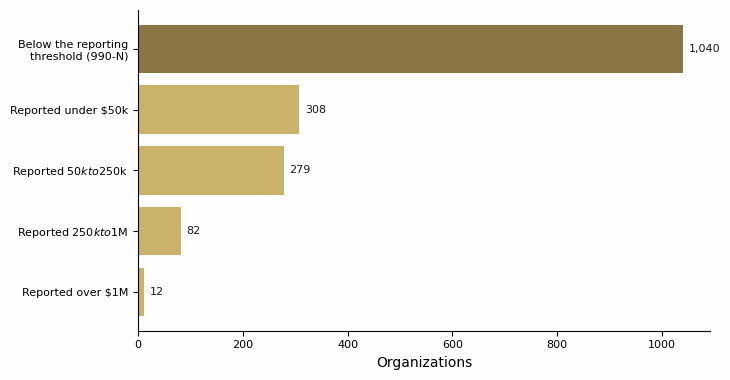
The 1,721 IRS-registered veteran-serving organizations in Illinois, by financial size. 1,040 of them (60%) file the 990-N postcard, which means they reported gross receipts under $50,000 and no detailed financials: mostly local posts, auxiliaries, and clubs. Only 94 organizations reported revenue above $250,000. The landscape is wide and mostly small. The darker bar marks the below-threshold group. [Sources: Internal Revenue Service, Exempt Organizations Business Master File, Illinois extract, file dated June 8, 2026; financial filings via the ProPublica Nonprofit Explorer API, accessed July 1, 2026.]
Who counts as "veteran-serving" here? The exact rule, published
There is no official flag for "veteran-serving" anywhere in federal data, so the definition is ours, and you deserve to see it. An Illinois organization is on this page if any of three lanes catches it (lanes overlap, so these counts add to more than the total):
- The IRS code lane (525 orgs). The IRS tags some nonprofits with an activity code. Code W30 means "Military and Veterans' Organizations." Any Illinois org carrying a W30 code is in.
- The name lane (1,535 orgs). Many older posts (VFW, American Legion) were registered before the IRS used those codes, so they carry no code at all. We also include any org whose registered name contains a veteran word or a known veteran organization name (the full word list is shown here).
- VETERAN
- VETERANS
- VFW
- VETERANS OF FOREIGN WARS
- AMERICAN LEGION
- AMVETS
- DISABLED AMERICAN VETERANS
- DAV
- MARINE CORPS LEAGUE
- PARALYZED VETERANS
- VIETNAM VETERANS
- IRAQ AND AFGHANISTAN VETERANS
- MILITARY ORDER
- GOLD STAR
- NAVY CLUB
- FLEET RESERVE
- The legacy-code lane (1,012 orgs). Before 1995 the IRS used a different code system. Code 907 meant "veterans activities." Orgs still carrying that legacy code are in.
What this rule misses: an organization that serves veterans without a veteran word in its name or a veteran code on file. A food pantry that mostly serves veterans is invisible to it. So every count on this page is a floor, not a census.
What this can and can't tell you: it shows how many veteran-serving organizations are registered with the IRS in Illinois and how big they are financially. "IRS-registered in Illinois" means the headquarters filing address is here, not that the org only works here. And a registration can outlive the org's real activity, so registered is not the same as active.
This is information, not advice. You decide if it applies.
County coverage: where the help is thin
If you want your hours to land where they're scarce, this is the view. It divides the organizations above by where Illinois veterans actually live. The surprise is at the top: Cook County, with more veterans than any other county, has nearly the thinnest coverage per veteran in the state.
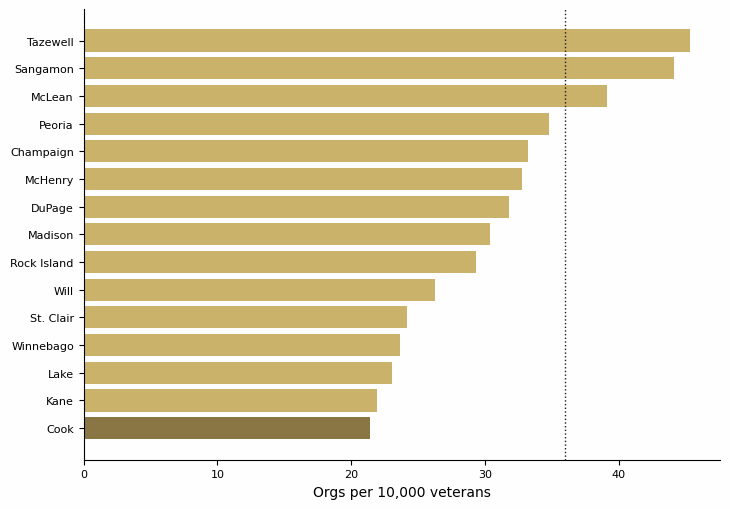
Veteran-serving organizations per 10,000 veterans in the 15 Illinois counties where the most veterans live. Cook County, home to 132,321 veterans, has 21 organizations per 10,000: the 2nd-thinnest coverage of all 102 counties. The darker bar marks Cook County. The full county table is in the download. [Sources: Internal Revenue Service, Exempt Organizations Business Master File; veteran counts from the U.S. Census Bureau, American Community Survey 5-year estimates (table B21001), the denominator for every rate on this page.]
What this can and can't tell you: it shows where registered organizations sit relative to where veterans live. It can't show service areas: an org headquartered in one county can serve ten, and a small county's rate moves a lot on a handful of orgs. Read it as a map of where infrastructure is thin, not a verdict on any county.
This is information, not advice. You decide if it applies.
The registration gap: veterans not registered with the state
Illinois keeps a database of veterans who have registered with the state's own Department of Veterans' Affairs (IDVA), the front door to state benefits help. Comparing it with the Census estimate of all Illinois veterans gives a rough read on who is connected and who isn't. This is one-on-one work: the gap is people, and they can be found one at a time.
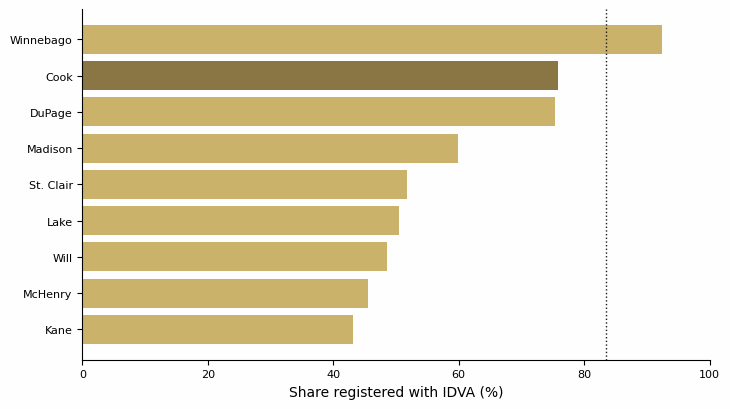
Share of veterans registered in the Illinois Department of Veterans' Affairs (IDVA) database, for the 9 counties with at least 10,000 veterans. Statewide, about 83% of Illinois veterans are registered, which leaves roughly 1 in 6 not connected to the state's help. In Cook County it is 76%, roughly 1 in 4 not connected. The darker bar marks Cook County. IDVA snapshot, February 2024. [Sources: Illinois Department of Veterans' Affairs veteran database by county (data.illinois.gov), snapshot dated February 2024; veteran estimates from the U.S. Census Bureau, American Community Survey 5-year estimates (table B21001).]
What this can and can't tell you: the chart shows only the 9 counties with at least 10,000 veterans, because the comparison gets unreliable below that: the state count is a February 2024 snapshot and the Census figure is a 5-year average, and in 57 small counties the snapshot actually exceeds the estimate. Statewide and in large counties the gap is a real, directional read. Registered with the state also isn't the same as receiving services, in either direction.
This is information, not advice. You decide if it applies.
Where the federal money already flows
Community problems attract programs, and programs leave a money trail. This is every federal grant program for veterans with money committed to Illinois recipients since fiscal year 2008. If you're building or scaling an organization, this is the funding landscape; if you're aiming at policy, this is what the current policy already pays for.
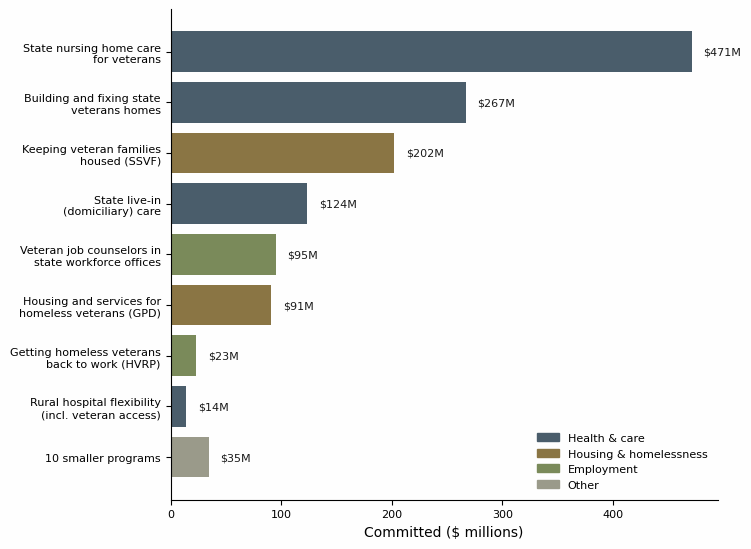
Since fiscal year 2008, federal veteran-program grants have committed $1.32 billion to Illinois recipients. That money flowed through 18 programs from 8 federal agencies. These are obligations: money committed on the books, not necessarily all spent. Agencies report the figures themselves. About 73 cents of every dollar goes to Illinois state government itself, mostly to run the state veterans homes. The largest nonprofit recipients are Volunteers of America of Illinois, Featherfist, and Salvation Army; the top ten are in the download. [Source: USAspending.gov, U.S. Department of the Treasury, Bureau of the Fiscal Service, accessed July 1, 2026. Program names shortened by us; official titles are in the download.]
What this can and can't tell you: obligations are commitments on the books, not dollars verified as spent, and agencies report their own numbers. The search reaches back to fiscal year 2008 only, and grants that serve veterans through general-population programs aren't counted. It shows the shape of the funding, not the quality of the programs.
This is information, not advice. You decide if it applies.
Who can officially help with claims
A big share of one-on-one veteran help runs through claims with the U.S. Department of Veterans Affairs (VA), and federal law controls who may prepare them. The VA recognizes certain veterans service organizations, and accredits individual representatives who work for them. Here are the organizations with accredited representatives based in Illinois. It is one measure of the state's claims-help capacity, and a picture of who the established players are.
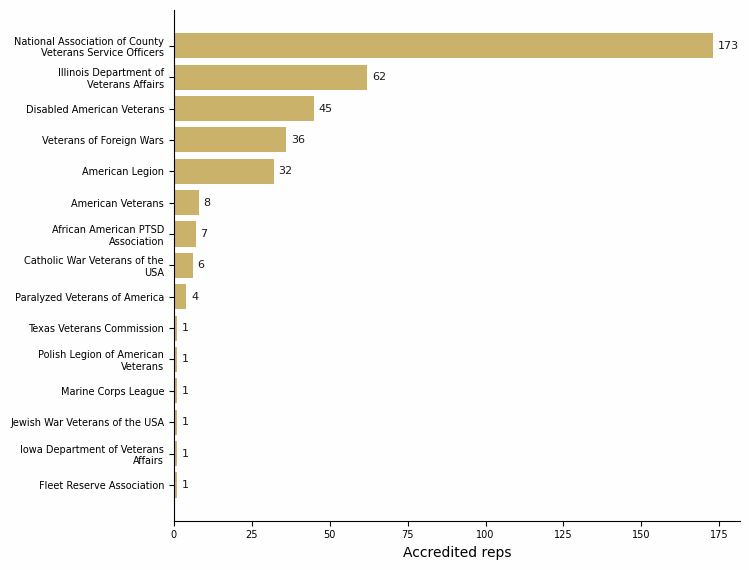
The 15 veterans service organizations recognized by the VA that have accredited representatives working from an Illinois address: 379 representatives in all. These are the people legally allowed to prepare and handle VA claims for free. A few entries are other states' veterans agencies whose accredited representatives work from Illinois addresses. Counts are organization-level on purpose; to find an individual accredited representative near you, use the VA's official search. Roster pulled July 1, 2026. Find an accredited representative on the VA's official search. [Source: U.S. Department of Veterans Affairs, Office of General Counsel accreditation records, retrieved July 1, 2026.]
What this can and can't tell you: it counts accredited representatives whose listed work address is in Illinois. A rep can serve veterans beyond that address, and organizations also serve Illinois from out of state. It says who is officially recognized to do claims work here, not who does it best.
This is information, not advice. You decide if it applies.
What tends to predict success
Each finding closes the same way on purpose: this is information, not advice. You decide if it applies.
-
Veterans already carry more than their share of this work.
Veterans volunteer about 35% more hours per year than non-veterans, and are about 30% more likely to belong to a civic group. Their volunteer time adds up to the work of about 220,000 full-time workers every year. If you take this path, you're joining the part of the community that already carries it. [National Conference on Citizenship, 2025 Veterans Civic Health Index, built on U.S. Census Bureau survey data.]
This is information, not advice. You decide if it applies.
-
The more engaged veterans are, the better they say they feel.
When researchers surveyed thousands of members of a veteran community organization, members reported stronger relationships, more sense of purpose, and better health. The more they engaged, the more of it they reported. Related peer-reviewed work links poor social reconnection after service with worse health and earlier death. That is exactly what this path works against. All of this is association, not proof: people who feel better may also engage more. [Syracuse University Institute for Veterans and Military Families, Team Red, White & Blue case study, 2016; Translational Behavioral Medicine, 2018.]
This is information, not advice. You decide if it applies.
-
Board service has a real, measured time cost. Know it going in.
In the field's benchmark survey, nonprofit board chairs reported spending about 26 hours a month on board work, and boards averaged about 7.5 meetings and 19.5 meeting hours a year, which is the floor before committees, prep, and fundraising. No solid published number exists for a typical non-chair board member, so plan from those two anchors. For what it buys: about 87% of chairs called the experience moderately or extremely rewarding. [BoardSource, Leading with Intent: Index of Nonprofit Board Practices, 2021.]
This is information, not advice. You decide if it applies.
-
A typical volunteer year is about 40 hours. Small is normal.
About 75.7 million Americans, 28.3% of everyone 16 and older, formally volunteered through an organization in the most recent federal count, and half of them gave 40 hours or less across the whole year. An hour or two a month is a real, normal contribution, not a token one. Most volunteers give small, steady amounts of time. [U.S. Census Bureau and AmeriCorps, Volunteering and Civic Life in America, 2023 data.]
This is information, not advice. You decide if it applies.
-
Burnout is how this path most often goes wrong.
In a national study of nonprofit leaders, 95% expressed concern about staff burnout, a third were seriously worried about their own, and three quarters said burnout was already costing their mission something. The people this work loses, it usually loses to exhaustion, not to lack of caring. Sustainability is part of the decision, not an afterthought. [Center for Effective Philanthropy, State of Nonprofits 2024.]
This is information, not advice. You decide if it applies.
More research: two more things worth knowing
Same rule as above: all of this is information, not advice. You decide what applies.
Most new nonprofits survive, and closures still happen. In an analysis of IRS data on every registered charity over fifteen years, about 12% disappeared from the records within five years and 17% within ten, a far better survival rate than for-profit startups, though small groups that fade quietly are undercounted. A separate financial model estimates about 4% of nonprofits close in a normal year. Starting an organization is a real bet, but not the long shot business startups are. [Harrison & Laincz analysis summarized in Nonprofit Quarterly, 2014; Candid, 2020.]
Volunteer time is worth real money. The standard estimate values a volunteer hour at $36.14 for 2025. Ten hours a month is roughly a $4,300-a-year donation. It's worth counting what you're giving, because organizations certainly do. [Independent Sector with the Do Good Institute, Value of Volunteer Time, 2025 estimate.]
Timing that might matter
Here's one real advantage: no federal benefit clock runs on this path. There is no benefits window that closes after a set number of years, no eligibility that expires. You can start at 25 or 65, scale up or down, step away and come back. The timing questions that matter here are about your life, not a benefits deadline.
The caregiving years
If you have aging parents, caregiving demand often peaks while parents are in their late 70s and 80s. Nearly half of care recipients are 75 or older, and the typical family caregiver is around 50: the same years most careers peak. Those two clocks often run at the same time.
[National Alliance for Caregiving and AARP, Caregiving in the U.S. 2025.]
This is information, not advice. You decide if it applies to your situation.
Tell the page your values on the main page (your age band comes from the Founder page's chart toggles) and any timing notes that fit will appear here.
What I can't show you
- Most community work never shows up in a federal dataset. Informal mentorship, church groups, unit reunions, one veteran helping another: invisible here, and probably most of the total.
- "Veteran-serving" is my definition, not an official flag. The full rule is published above, and what it misses means every count on this page is a floor.
- Registered is not the same as active. An IRS registration can outlive the organization's real activity. I show filing recency, but "still alive" is not fully knowable from filings.
- Headquarters county is not service area. The coverage map shows where organizations sit, not everywhere they reach.
- The registration gap compares a February 2024 snapshot with a 5-year population average. It's a directional read, strongest statewide and in large counties; in 57 small counties the numbers can't be compared at all, and the page says so.
- Money committed is not money spent, and neither is a measure of whether a program works.
- No outcomes data exists here. Nothing on this page measures whether any organization's programs actually work, and no dataset measures the thing this path runs on: whether the work would matter to you.
Should you stay or go?
If you're weighing other states, here is the same veteran-org density measure, computed the same way with the same published definition, for the states veterans often weigh against Illinois. The result is lopsided: Illinois has roughly double the registered veteran-org density of any of them. If community infrastructure matters to your decision, Illinois is unusually dense with it. If you want to build where there's less, that cuts the other way.
Veteran-org density, by state
| Measure | Illinois | California | Texas | Colorado | Washington |
|---|---|---|---|---|---|
| Veteran-serving orgs (IRS-registered) | 1,721 | 2,311 | 2,278 | 643 | 670 |
| Veterans living there | 478,196 | 1,305,453 | 1,402,357 | 342,276 | 473,124 |
| Orgs per 10,000 veterans | 36 | 18 | 16 | 19 | 14 |
Counts use the same three-lane definition in every state, so the comparison is apples to apples, and the same caveats apply everywhere: registered is not active, headquarters is not service area, and the definition is a floor. [Sources: Internal Revenue Service, Exempt Organizations Business Master File, per-state extracts dated June 2026; veteran counts from the U.S. Census Bureau, American Community Survey 5-year estimates (table B21001).]
Weighing a specific state I didn't include? Tell me with the Share feedback link at the bottom of this page and I'll prioritize it.
Taxes change with your state
Where you legally reside changes how your military retirement and VA disability income are taxed, and what property-tax breaks you qualify for. Illinois doesn't tax retirement income, including military retirement. Texas and Florida have no state income tax, and both offer up to a full homestead property-tax exemption for 100% disabled veterans. California still taxes military retirement above a partial exclusion (up to $20,000 a year starting with tax year 2025, with income limits, and that provision is set to expire before 2030). If "should you stay or go" is a real question for you, the tax math is part of the answer. Verify against each state's revenue department before you decide.
[Illinois Department of Revenue; Texas Comptroller; Florida Statutes; MOAA state tax updates. Verify with each state's revenue department.]
This is information, not advice. You decide if it applies to your situation.
An honest check before you decide
- How many hours a month can you actually give after work and family take theirs? What happens to the commitment in the months when work gets heavy?
- The research says this path most often goes wrong through burnout, not lack of caring. Who notices when you're running empty, and have you told them to watch?
- If you're thinking of building an organization: the mission is the reason, but the work is fundraising, filings, and meetings. Are you signing up for the machinery too?
Thinking of making the mission your full-time work instead? See the Founder path.
Before you go
Get updates when new data or a new path ships (one confirmation email first, unsubscribe anytime). Or answer three quick feedback questions; your answers tell me whether to keep building these.
Support the work · offsets the data and build costs. Optional.